


















The comments section. That’s where it’s all happening right now.
While most brands are still obsessing over feeds and reach, culture has already moved somewhere else; to the replies, the stitches, the quote posts, the off-the-cuff moments that can’t be scheduled in a calendar. That’s where audiences are shaping meaning in real time. And whether brands like it or not, they’re part of that conversation.

When culture talks back
The traditional campaign arc — launch, spike, silence, doesn’t work anymore. Culture doesn’t move in neat, scheduled cycles. It moves in chaos, it moves in comments. According to research from OK Cool, 91% of people spend time in the comments section of social platforms, and 65% say comments are funnier than the creators or brands themselves.
Today’s audience expects a reply. A nod, a clap-back, and importantly, a human. They want brands to be part of the conversation, not just the ones starting it. That’s where creative consistency actually matters, not just in the visuals or the tagline, but in the tone. In how you show up, how you respond, and how you handle a joke at your expense.
The comments are canon
Scroll any major brand’s page and you’ll see it, the conversation is the content. Audience replies are writing the second layer of the story, and often, they can make or break a campaign’s success.
Every post, ad, or video has two narratives now: the one you made, and the one people make in response. It either clicks or it collapses, and increasingly, the comments are what decide which way it goes.
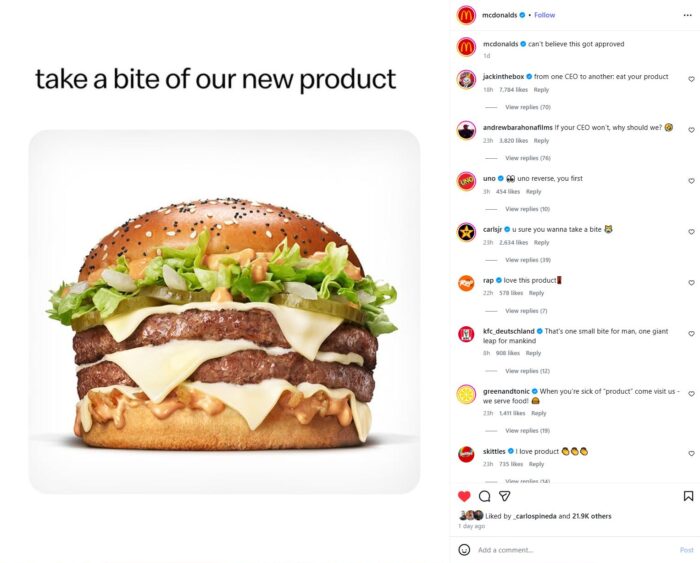
McDonald’s recent Big Arch launch is a near-perfect case study in what this looks like under pressure. When their chronically corporate CEO went viral for a cringey taste test; took a tiny bite and referred to the burger as “product” twice, the internet piled on. Burger King’s president immediately posted himself taking a massive bite of a Whopper. It was bad. But on launch day, McDonald’s posted a close-up of the Big Arch with the caption: take a bite of our new product. They made fun of themselves. They joined the joke instead of running from it. And every meme, every roast, every piece of pile-on content became free awareness on the exact day the product launched. You can’t buy that kind of reach, but you can throw it away by ghosting or getting defensive.
Smart brands treat the comment section like an extension of their creative, jumping in, riffing back, adding context, even laughing at themselves. But it’s no longer just about quippy one-liners; it’s about having a perspective and genuine tone of voice. Something to actually contribute to the culture you want to be part of.
What smart brands are doing with it
There are two ways this plays out, and both matter.
Layer one is your own comments section. This is where community is built or lost. Brands that show up consistently, responding, riffing, occasionally laughing at themselves; are turning passive viewers into invested audiences. Some agencies call comments “the new brief,” treating feedback threads as real-time research: listening for themes, tone cues and cultural signals that shape what gets made next. If a joke lands, they build on it. If a comment section catches fire, they turn it into content — like Maccas did.
Every interaction becomes a way to sense-check what resonates, and refine the next idea before the brief is even written.
Layer two is showing up where you weren’t invited. This is where the real reach lives. The brands getting it right aren’t waiting for their audience to come to them — they’re jumping into conversations they have no obvious business being in.
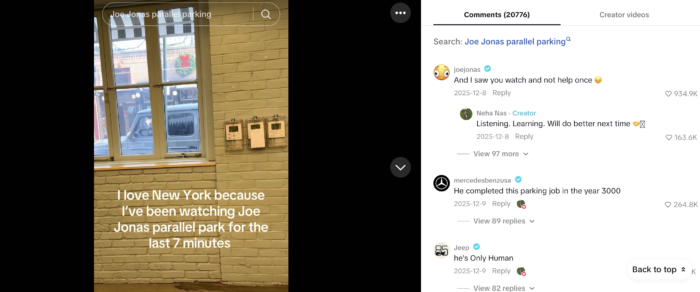
Take Audible. Their agency VML treats the comment section as a low-cost, high-speed creative testing ground. Chief social officer Liz Cole describes it as a way to “test things in a lightweight way that doesn’t require a whole big production every time.” Similarly, when a TikTok of Joe Jonas spending seven minutes trying to parallel park his G-Wagon in Manhattan went viral, Mercedes-Benz jumped into the comments writing “He completed this parking job in the year 3000,” a cheeky nod to his Jonas Brothers hit, and a dig at the irony of someone struggling to park a car they make. That quick commentary hit 264.k likes. No brief, no budget, no production, just someone plugged into social culture and moving fast. Jeep also followed suit with another song pun, earning themselves a solid 161k likes. Turns out the lowest production cost in marketing is a well-timed comment. These brands figured that out.
The Judgment Call
Of course, not every conversation is worth jumping into, and the brands that do this well know the difference. The filter isn’t “is this relevant to our product?” It’s “do we have something genuinely funny, useful or importantly, human to add?” If the answer is no, minding your own business is the right move. If the answer is yes, move fast, comment sections have a shelf life, and a joke that lands on day one is done by day 3.

Human beats hype
In a feed full of recycled AI slop and same-same aesthetics, what actually stops the scroll? It’s not polish, or big budget production value. It’s personality.
Being human is now the differentiator. Audiences can tell when a response is written by a person who gets it, versus a brand trying too hard to sound like one. That’s why the most memorable moments aren’t the flashy campaign launches anymore; they’re the one-line replies, the clever retorts, the human touches that show someone’s actually there, and they’ve got a sense of humour.
So next time you post a video, don’t just watch the view count. Watch the comments.
That’s where your brand voice is being tested, and where your next big idea probably already exists.
By Katie Martlew
Senior Content Strategist – We Know Video